Colombia Importers
Companies able to define the importing entity, destination city or sales region, customs route, local responsibilities and exact wholesale order version.
Colombia Blender Use-Case & Duty Profile
Choose a blender by the work it must perform, convert that use case into one jar, blade, coupling and motor architecture, then approve the Spanish packed kit and inspection matrix for the intended Colombia channel. Wholesale only. MOQ starts from 1000 PCS.
Direct Buyer Answer
No. The buyer should first define ingredients, starting condition, batch size, cycle frequency, expected texture and channel. Those facts determine the jar, blade, coupling, motor, controls and accessory set that must be sampled as one packed unit. A wattage headline or multi-function label does not establish the required operating result or carton contents. Yaoyuan can coordinate current model records, samples, packing files and available factory evidence; qualified Colombian parties retain local import and market-entry decisions. Wholesale only; MOQ starts from 1000 PCS and the final configuration receives a private quotation.
Buyer Qualification
Companies able to define the importing entity, destination city or sales region, customs route, local responsibilities and exact wholesale order version.
Buyers selecting a controlled blender range for appliance dealers, regional wholesalers and established retail channels.
Purchasing teams requiring approved Spanish retail packing, barcode, importer identity, master-carton records and repeat-order control.
Businesses ready to release brand files, Spanish artwork, warnings, manual, labels and one exact product specification.
Importers combining controlled blender models with air fryers, fans, rice cookers, water pumps or other small appliances.
Wholesale only. MOQ starts from 1000 PCS. Public prices are not displayed. Retail and one-piece orders are not supported.
A useful Colombia blender brief starts with the task: ingredients, starting condition, batch weight or volume, number of cycles, rest time, expected texture and the channel that will sell the product. Only then should the buyer select the jar, blade, coupling, motor, controls and accessory set. This order prevents a catalog wattage or capacity headline from replacing the operating result the distributor actually needs.
Record the complete sale kit, including every jar, cup, lid, center cap, gasket, blade unit, mill or accessory, Spanish box, manual and carton. A 3-in-1 or 8-in-1 label is not a packing list, and a power rating is not a durability result. Yaoyuan Electric can coordinate current product records, samples, available technical files and factory evidence. Qualified Colombian parties remain responsible for local classification, authorization, customs, tax and destination-market decisions.
Instead of filling a range with similar capacities, give each blender a different operating and channel role. An entry route may serve simple household drinks with a controlled accessory set. A core route may add jar size or a second cup without multiplying service parts. A step-up route may justify stronger architecture or multifunction attachments for a defined customer group. Juicer and high-power directions should stay separate until the buyer states the exact job they must perform.
A controlled opening range is easier to inspect and support than several similar-looking models competing for the same shelf position. Separate the lead model, repeat-volume model and optional extension. Use the blender model selection guide, product selection matrix and retail assortment route before allocating MOQ by SKU.
Turn the operating brief into a component record. Identify jar material and geometry, usable fill line, handle and base interface, lid and center cap, gasket, blade count and geometry, blade mounting, shaft, seal, coupling, motor direction, controls, feet, cord, plug and every attachment. For dual-cup and multifunction models, assign an identity to each cup, jar, mill, lid and blade rather than treating the title as a complete definition.
A change to the jar, lid, coupling, blade, bearing, motor, switch, control board or accessory can affect fit, operation, noise, service parts and test results. Keep the signed specification, approved sample, Spanish artwork, purchase order, inspection checklist and packing list connected to the same revision. Use the sample approval guide, order handover route and component change control to preserve that identity.
These fields come from published catalog records and help compare candidate architectures. They are not a current quotation, signed specification, certification statement or performance promise. Each route requires a current sample, a defined operating job and written order-version confirmation. Published power is an electrical rating. Published carton and loading fields remain model-specific references that must be reconfirmed before cost or container planning.
Candidate for a controlled dual-cup job. Its page lists 2.5L, 350W, AC220-240V, a 270 x 200 x 330mm box and a 620 x 280 x 670mm carton. The trial kit must identify both cups, lids, blade units and current carton quantity.
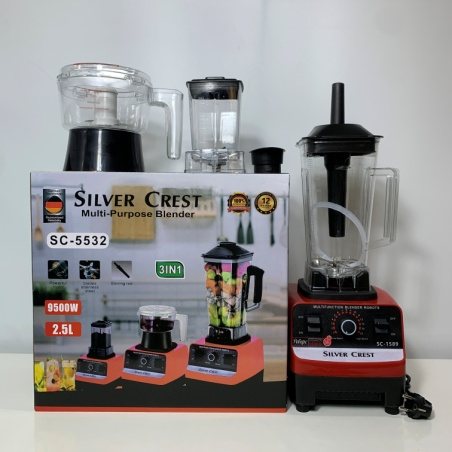
Candidate for a multifunction core route. Published fields are 3.5L, 800W, AC220-240V, a 395 x 213 x 375mm box and a 655 x 514 x 765mm carton. Define the three jobs and every included part before writing the load matrix.
Candidate only when the buyer needs a broader accessory architecture. The record lists 3L, 800W, AC220-240V and PC, PET, PP plus 201 stainless steel. Create an eight-piece identity map and test the complete current sample.
Candidate for a separate juicer job rather than a generic blender slot. The page lists 3L, 1000W, AC220-240V, Plastic PP and a 785 x 455 x 405mm carton. Keep the P34 page identity because no public model code is shown.
Candidate for a defined higher-power task. Its record lists 2L, 2400W, AC220-240V, 201 stainless steel plus PC and optional glass. The public loading reference cannot enter the Colombia cost file until the current carton basis is verified.
Use the wider catalog to discover architecture alternatives, then advance only the models that solve a named use case with a testable packed kit. Missing fields stay open until current records close them.
Send the required rated voltage, frequency, plug, cord and rated-label direction before sample approval. The published AC220-240V catalog lines are discovery records, not proof that those versions suit the Colombian order. Any requested electrical change must be reviewed for the exact motor, controls, cord, plug, rated label and model configuration before the buyer approves artwork or a sample.
Keep the sample, nameplate, plug, cord, manual, available test evidence and production record under the same electrical identity. If one purchase order contains more than one version, separate the SKU, quantity, artwork and inspection records. Use the blender electrical guide, Latin America version-planning guide and supplier evidence pack to organize the review.
Use the exact model construction, rated identity, materials, function and intended use to support a proposed tariff classification. Colombia's DIAN tariff consultation allows importers and advisers to review nomenclature and measures by subheading or product text. The result should be recorded in the buyer file together with the responsible customs adviser, open assumptions and any documents still required.
Colombia's VUCE import module is used for import registrations and licenses where goods are subject to prior requirements, permits or authorizations. That does not mean every blender follows the same VUCE route. The importer and qualified Colombian parties should confirm whether the exact model requires a registration, license, conformity route or other approval before purchase-order release.
Do not apply one generic electrical-compliance claim to every blender. Review the current technical scope for the exact appliance, components, intended use and electrical version. Yaoyuan Electric can coordinate current product records, component information, samples, labels and factory-side documents; the importer remains responsible for local classification and market entry. Start with the official DIAN tariff consultation, the official VUCE import services and the current Ministry technical-regulation information.
Spanish OEM artwork is one part of the complete shelf-ready kit. Product logo, controls, rated label, warnings, manual, barcode, importer or distributor identity, individual box and master-carton marks must identify the same model, mains version and accessory set. The buyer supplies accurate destination text and approves translations, legal wording and claims. The factory should not invent importer data, certification marks, performance claims, ingredient claims or market statements.
Build one artwork register showing file name, dieline, model, electrical version, translation owner, approver, revision and approval date. Compare the box proof with the exact product and complete accessory set. Confirm that the barcode, model, capacity, rating, plug image, importer identity and carton marks agree across files. Use the OEM blender packing guide, artwork approval route and OEM blender program before mass printing.
Turn the intended use into a repeatable load test instead of accepting a wattage headline. Define ingredient, quantity, liquid ratio where relevant, starting condition, operating time, rest time, speed or pulse setting, input supply, number of cycles, observation method and acceptance result. A sample video can support review, while the written matrix allows the same operation to be repeated before production and during inspection.
Include jar and lid fit, leakage under the agreed fill condition, blade and coupling operation, control response, speed or pulse operation, stability, vibration, sound observations, shutdown behavior and post-test condition. Factory observations are commercial sample evidence, not a substitute for any formal test or local approval required for the exact product. The blender inspection guide, golden sample route and pre-shipment release guide provide the control sequence.
Identify every part that contacts ingredients: jar, lid, cap, gasket, blade, shaft, seal and any mill or cup. Record the material statement for the exact approved route and keep supplier declarations or available test reports linked to that model and revision. A material description on one catalog page must not be transferred to another product.
The importer should define any destination test, declaration or documentation requirement with qualified Colombian parties. The factory can assemble the available model-specific evidence pack, but a generic material name does not prove conformity, migration performance, durability or suitability for every ingredient and use condition.
Colombia distributors and private-label buyers should discuss practical service parts before the order is closed. Depending on the exact model and technical supportability, this may include a jar, lid, center cap, gasket, blade assembly or coupling. Record the part code or controlled identity, compatible model, quantity, packing and responsibility for local replacement. Similar capacity or appearance does not prove compatibility.
For multifunction sets, map each jar, cup, blade and lid to the approved model. Optional service parts must not appear as standard accessories in artwork unless they are packed with every saleable unit. Use the blender spare-parts guide, appliance after-sales planning route and repeat-order planning guide.
Place the complete sellable kit on the comparison sheet: exact model, jar, lids, blades and accessories, destination electrical version, Spanish packing, required evidence, inspection, individual box, units per carton, carton dimensions, net and gross weight, inland handling, freight basis, destination charges, duties and taxes assessed by qualified parties, local delivery, finance and service reserve. A larger jar or multifunction set changes freight and support exposure even when its machine-only price appears attractive.
SC-1589 publishes a 620 x 280 x 670mm carton, SC-5532 publishes 655 x 514 x 765mm and P34 publishes 785 x 455 x 405mm. These dimensions do not produce a reliable cost per saleable unit without current units-per-carton and weight data. BF-5042 does not publish a final carton on the source page used here. Y66's public loading reference requires verification against the current carton and packing revision.
Obtain a current packing sheet for every SKU, then reconcile carton count, CBM and weight for a standalone blender order or mixed container. Use the carton and CBM guide, blender landed-cost guide, quotation comparison sheet and mixed-container route.
The approved sample file should identify catalog route or model, revision, jar, lid, blade, coupling, motor base, controls, accessories, electrical label, plug, cord, color, logo, Spanish artwork and packing. Photos should show the complete supplied set and identifying details. Inspection should reference that file, the purchase order, lot and agreed sampling basis.
Check identity, appearance, assembly, accessories, labels, manual, barcode, individual box, carton marks and the written operating matrix. Record defects and disposition before shipment authorization. Container evidence should connect carton count, loading condition, seal information and shipping documents to the released order. Use the container loading route, factory evidence system and customer order evidence journey.
Public prices are not displayed because the operating job, model architecture, jar system, accessories, electrical version, Spanish OEM scope, packing, inspection, destination and trade term change the quotation basis. One complete brief lets the sales team prepare a commercial version that can be tested and compared on the same basis.
Use COLOMBIABLENDER1000 in your WhatsApp message. Wholesale only. MOQ starts from 1000 PCS. No public prices, retail orders or single-piece orders.
That should not be assumed. The buyer's adviser reviews the exact construction, function, mains identity, components and intended use against current Colombia requirements.
After the model, complete accessory kit, rated identity and permitted claims are fixed. The buyer supplies and approves translation, importer data, barcode and warnings.
A repeatable load matrix using the agreed ingredient, quantity, cycle, supply and acceptance result. Wattage by itself is only an electrical rating.
Not by appearance. Compatibility needs the exact finished-good revision and controlled part identity, including the base interface, shaft, seal and coupling.
The quoted object includes a defined operating job, architecture, accessory kit, mains version, Spanish pack, inspection route, destination and trade term.
Importers, distributors, wholesalers, supermarket teams and OEM brand owners placing bulk orders. Retail and single-piece orders are outside this route.
Wholesale Only
Bulk blender programs begin from 1000 PCS, with SKU allocation and OEM feasibility reviewed against the operating brief.
Use case, architecture, load matrix, mains identity, Spanish kit, packing and inspection must all point to one approved revision.
Pricing begins when the operating job, quantity, packed kit, destination port and requested trade term are coherent.
Long-Term Market Development
Use this route when your team can share channel evidence, target landed-cost logic, inventory and service constraints, and a repeat-order plan. Yaoyuan can coordinate the selected blender / juicer version, OEM files, supplier resources, inspection and replenishment decisions. Demand, exclusivity, delivery, sales volume and margin are not promised before both parties review the evidence and responsibilities.